




Skip to Content

Karna

CHAPTER I — KARNA
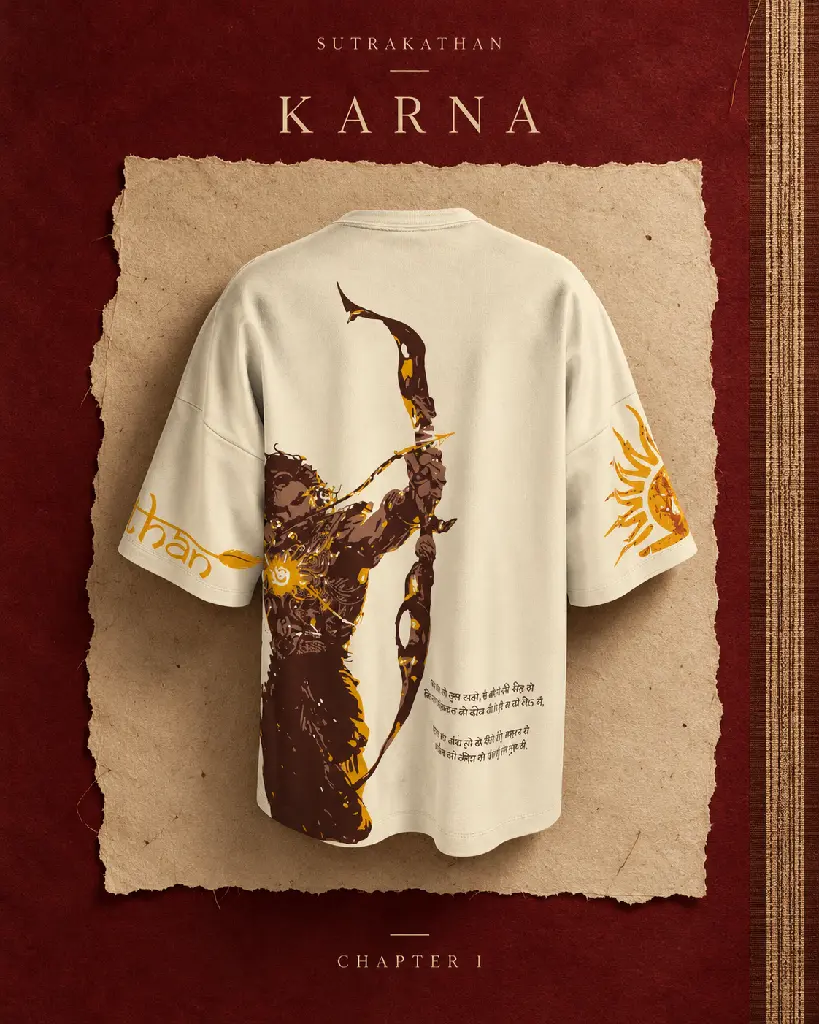
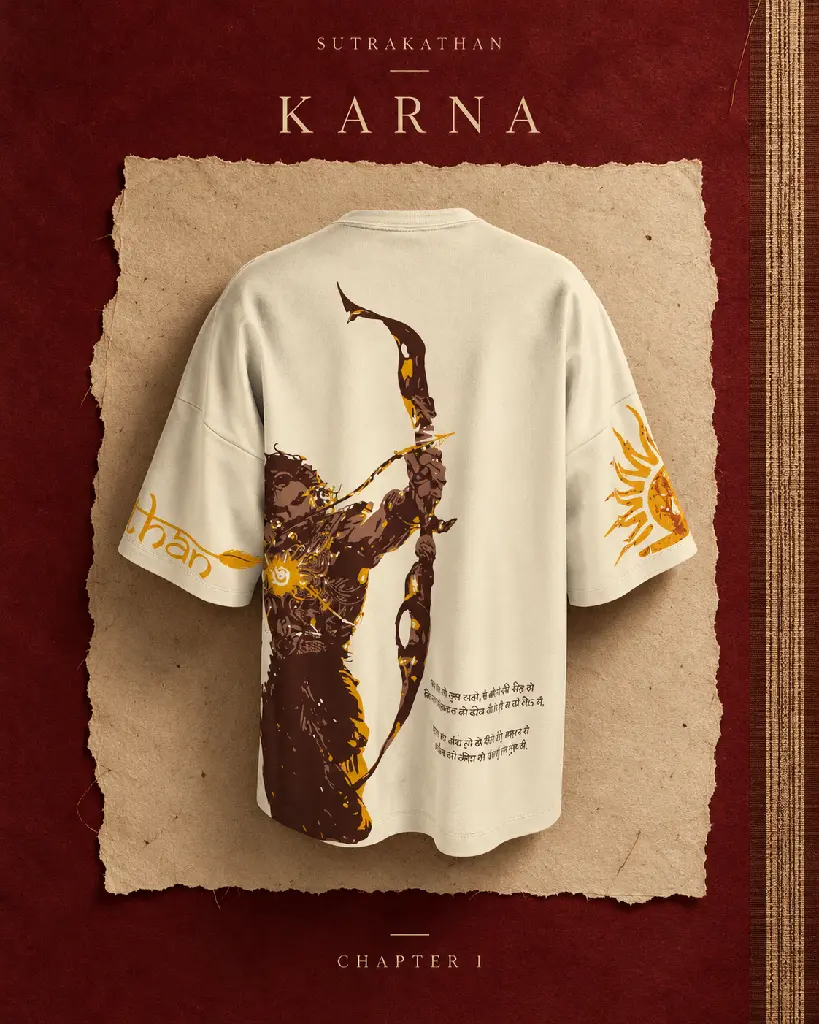
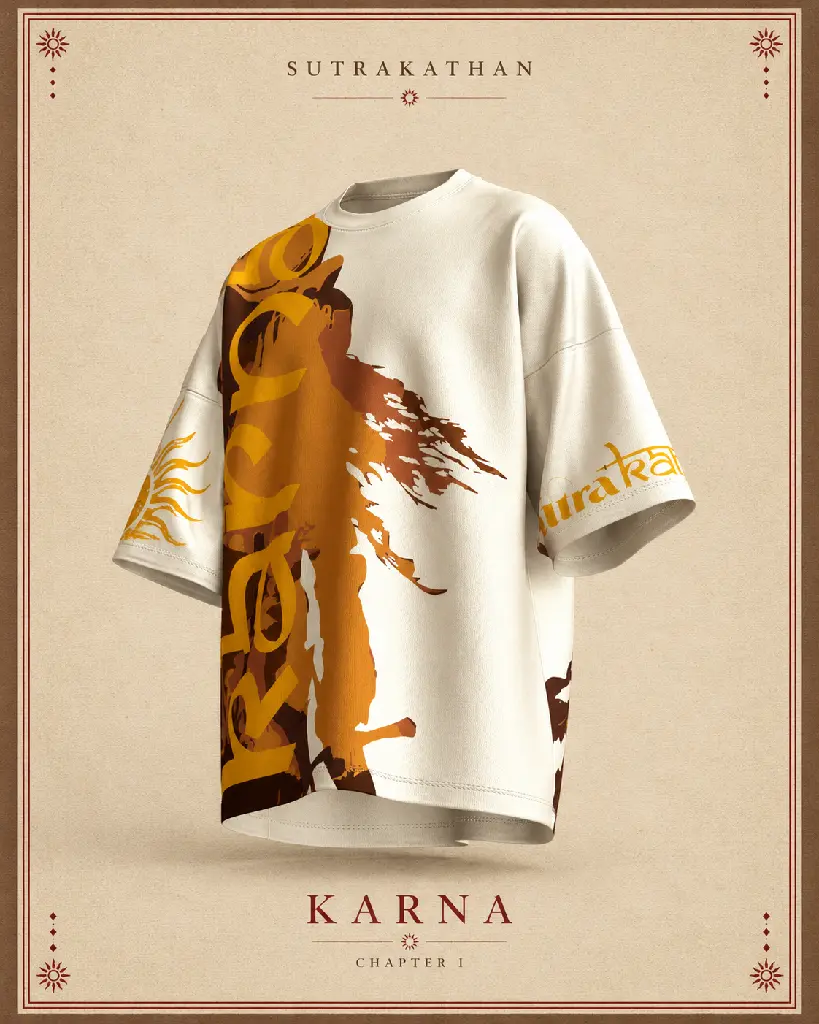
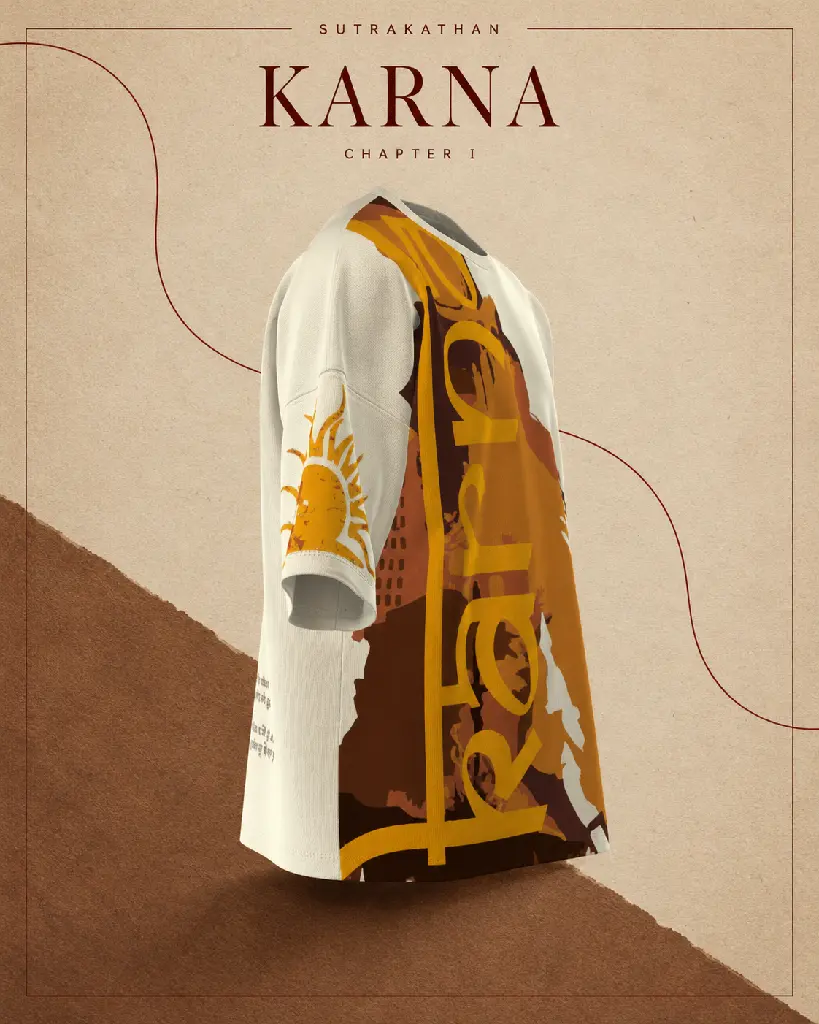
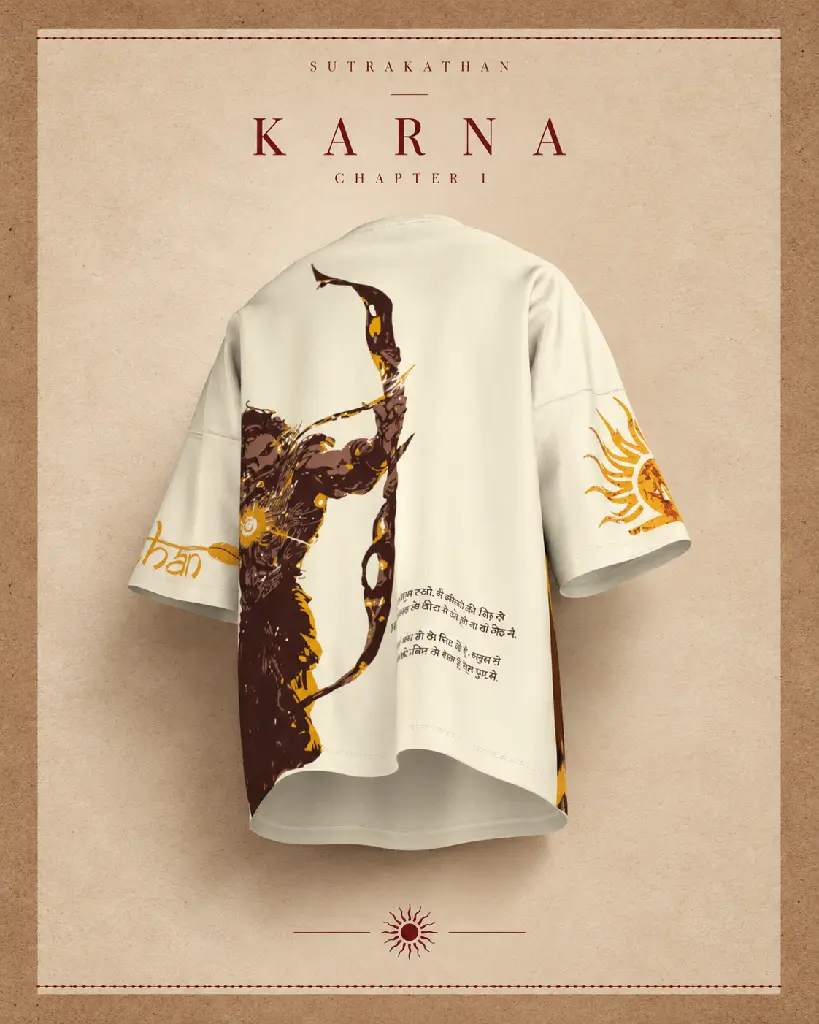
A study in radiance and resolve. Sun motifs, an archer and bold ochre typography meet on an ivory canvas, bringing the visual language of Karna into the present.
Discover the details in the front and back views. Available in S, M, L, XL and XXL.

PRE-ORDER — Limited stock. Shipping begins 14 November 2026, our official launch date. Free shipping. 14-day returns.
₹ 2,199.00 ₹ 2,199.00
  • Size
PRE-ORDER · Limited stock · Shipping begins 14 November 2026 · Free shipping · 14-day returns. For order support, call +91 98985 08833.
Size & fit help

Choose your size above to see current availability. For garment measurements and help choosing your fit, contact us before ordering.

Call +91 98985 08833
Delivery & returns

Pre-orders are open while stock lasts. Free shipping. Dispatch begins 14 November 2026, our official launch date. Delivery timing depends on your destination after dispatch. Request returns within 14 days of delivery. Contact us with your order number for instructions.

Read shipping and returns

Sutrakathan · Chapter I · The story behind the garment

सूर्यपुत्र कर्ण

SURYAPUTRA KARNA

Born of the sun.
Raised by love.
Tested by belonging.

A life shaped by generosity, ambition, loyalty, and impossible choices.

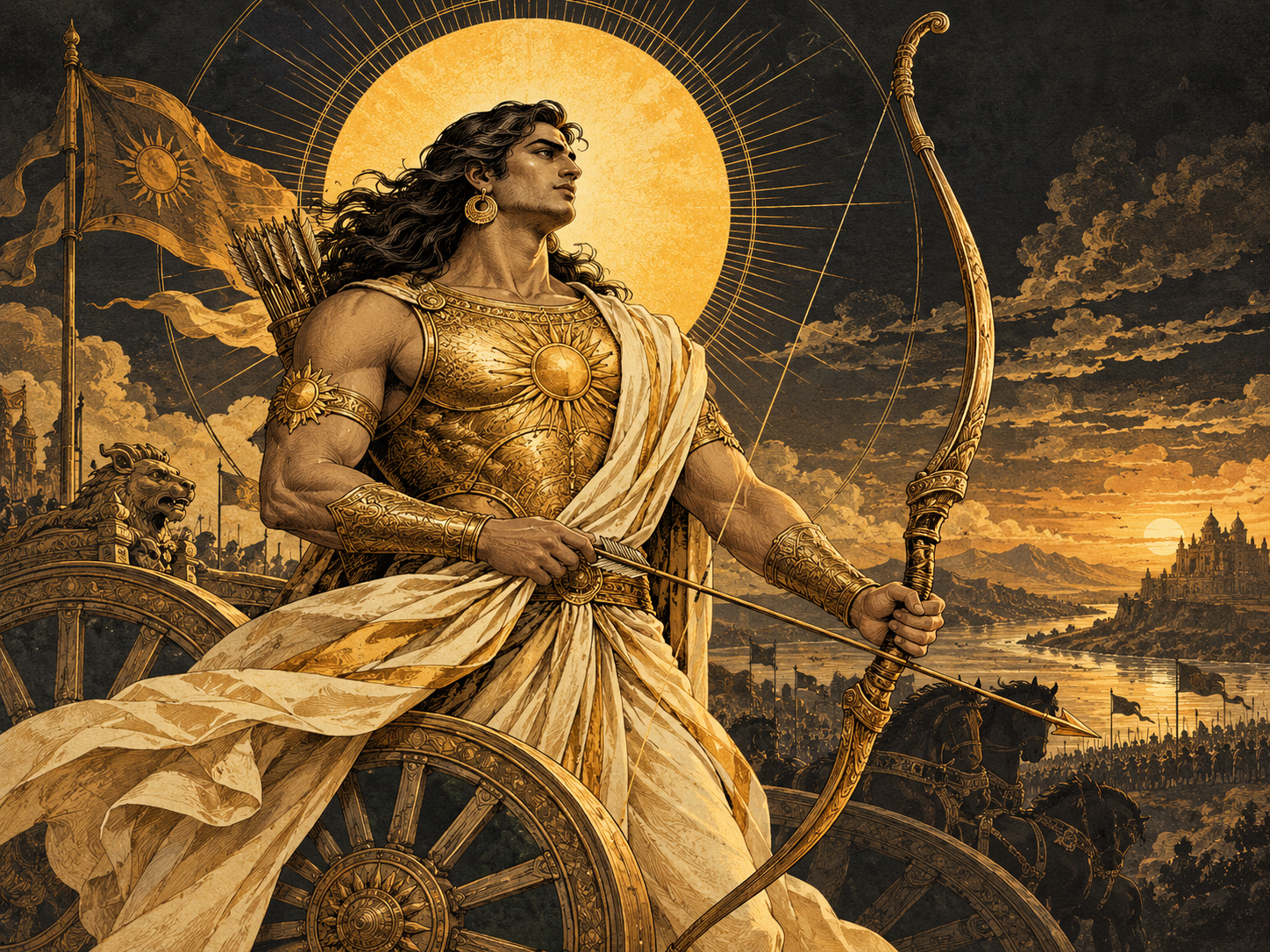
Original illustration of Karna in golden armour holding a bow beneath a radiant solar disc, with chariot-wheel geometry below.
Artistic interpretation inspired by the Mahabharata.
A LIFE BETWEEN LIGHT & SHADOWSTORIES WOVEN WITH THREADS.

01 / An illustrated journey

One life.
Many loyalties.

A literary journey through the Mahabharata, following Kisari Mohan Ganguli’s translation. Open a chapter to read further.

View the T-shirt
A

A celestial beginning. A human home.

The child of Surya

Born to Kunti through Surya, he entered the world with natural armour and earrings. Yet it was Adhiratha and Radha who gave the abandoned child a home.

Explore this chapter

Kunti, unmarried and afraid of the consequences of his birth, set her infant afloat in a carefully prepared basket. Radha found it in the Ganga; Adhiratha opened it, and they welcomed the child as their son. Adhiratha later sent him to learn arms. Their care was central to the identity he would defend.

He was named Vasusena in connection with the precious armour and earrings he bore. Radheya means son of Radha; Suryaputra means son of Surya. These names hold together his upbringing and divine birth.

Read the episode: Vana Parva, CCCVI–CCCVII · Vana Parva, CCCVII · Udyoga Parva, CXLI

B

Ability enters the arena. Lineage follows.

The struggle to be recognised

At the princes’ tournament, Karna repeated Arjuna’s feats and challenged him. Before a duel could begin, Kripa demanded his family and royal lineage.

Explore this chapter

The question turned a display of skill into a test of social standing. Karna’s response was silence and visible distress. This episode reveals a barrier without making his whole life a story of universal rejection: the epic also records teachers, allies and royal recognition. His rivalry with Arjuna became a defining pursuit.

Read the episode: Adi Parva, CXXXVIII · Vana Parva, CCCVII

C

Knowledge gained. A cost deferred.

Learning, ambition, and curses

Karna sought the weapons that might let him equal Arjuna. His training under Parashurama—and an unrelated accident—brought two distinct curses into his story.

Explore this chapter

After learning from Drona, Karna sought the Brahma weapon; Drona restricted that instruction by status and discipline. Karna then approached Parashurama claiming to be a Bhargava Brahmin. When he silently endured a worm boring into his thigh rather than wake his resting teacher, his endurance exposed the deception. Parashurama cursed the crucial knowledge to fail him at his hour of need.

Separately, Karna accidentally killed a Brahmin’s cow. The bereaved owner cursed his chariot wheel to sink during his decisive combat. These are different episodes. Ganguli’s account identifies the worm as the cursed being Dansa, not Indra in disguise.

Read the episode: Santi Parva, II · Santi Parva, III

D

Recognition becomes a bond.

The crown of Anga

Duryodhana answered the tournament’s challenge to Karna’s rank by making him king of Anga. The coronation bound public honour to personal friendship.

Explore this chapter

Karna asked how he could repay a kingdom; Duryodhana asked for friendship. Their embrace sealed a relationship that outlasted the ceremony. Years later, facing a chance to join the Pandavas, Karna treated Duryodhana’s trust and support as obligations he could not abandon.

Read the episode: Adi Parva, CXXXVIII · Udyoga Parva, CXLI

The story continues. The garment is always within reach.View the T-shirt
E

The gift was also a bargain.

Generosity at a cost

Warned by Surya, Karna knew why Indra wanted his natural armour and earrings. He surrendered that protection in exchange for a formidable weapon.

Explore this chapter

Indra arrived as a Brahmin petitioner. Karna first offered other gifts, then recognised him and asked for a return boon. Following Surya’s counsel, he requested an infallible dart. Indra limited its use: it would slay one powerful foe, then return to him. Karna accepted those terms and cut away his armour and earrings.

The episode joins a costly commitment to giving with calculation and martial ambition. It is not an exchange without conditions.

Read the episode: Vana Parva, CCC · Vana Parva, CCCVIII

F

A new identity could not erase an old life.

The truth of his birth

Krishna revealed that Karna was Kunti’s eldest son and offered him kingship among the Pandavas. Karna refused to exchange the people who had sustained him for a new future.

Explore this chapter

He spoke of Adhiratha and Radha’s care, his established family, and Duryodhana’s reliance on him. Kunti later appealed to him herself. He remained with Duryodhana, but promised not to kill Yudhishthira, Bhima, Nakula or Sahadeva.

Arjuna was the exception. Kunti would still have five sons, he said: either Arjuna would survive, or Karna would take his place. The promise preserved their rivalry even as it acknowledged their kinship.

Read the episode: Udyoga Parva, CXL · Udyoga Parva, CXLI · Udyoga Parva, CXLVI

G

A weapon spent. A command inherited.

The warrior of Kurukshetra

Karna used Indra’s one-use dart to kill Ghatotkacha, losing the weapon he had reserved for Arjuna. After Drona’s fall, he took command of the Kaurava army.

Explore this chapter

Krishna had sent Ghatotkacha against him to draw out the fatal weapon and protect Arjuna. Karna’s later installation as commander placed him at the centre of the Kaurava war effort. His final confrontation with Arjuna brought their long rivalry to its decisive battlefield encounter. His skill was formidable; the epic does not require us to call him undefeated.

Read the episode: Drona Parva, CLXXXII · Karna Parva, 10 · Karna Parva, 90

H

The wheel stopped. The grief did not.

The end and the revelation

In the final duel, Karna’s chariot wheel sank and crucial weapon knowledge failed him. Arjuna killed him; only afterwards did the Pandavas learn they had lost their elder brother.

Explore this chapter

Karna appealed for a pause under the rules of combat. Krishna answered by recalling earlier wrongs, including Draupadi’s humiliation. The fighting continued; Karna again tried to free the wheel, and Arjuna, urged by Krishna, struck the fatal blow while it remained trapped.

The account holds battlefield vulnerability, past choices and the fulfilment of curses together. Its moral tensions resist a single easy verdict. After Kunti disclosed their kinship, Yudhishthira grieved deeply over the brother whose identity he had not known.

Read the episode: Karna Parva, 90 · Karna Parva, 91 · Santi Parva, I

02 / What he fought for

The need to belong.
The weight of a choice.

An interpretation of the episodes—not a declaration that every choice was just.

Recognition & dignity

The tournament makes ability and inherited standing collide. Karna’s ambition asks to be seen beyond the family society assigns him.

Loyalty & gratitude

Anga and Duryodhana’s trust become a debt he will not set aside, even when Krishna offers a different future.

Giving & ambition

The armour episode combines generosity with a warrior’s desire for a decisive weapon. Both belong in the story.

Honour & identity

His attachment to Radha and Adhiratha lives alongside his fierce rivalry with Arjuna. Birth does not simply replace belonging.

These personal motives served Duryodhana’s political cause. They do not turn Karna into a modern campaigner for universal equality, or make all his actions consistent with dharma.

Read the episode: Adi Parva, CXXXVIII · Vana Parva, CCCVIII · Udyoga Parva, CXLI · Udyoga Parva, CXLVI

03 / Achievements and legacy

A formidable life.
A complicated legacy.

View the T-shirt
ACHIEVEMENT

King of Anga

A royal position bestowed by Duryodhana at the tournament.

MARTIAL STANDING

Archer and commander

A highly skilled warrior, later entrusted with command of the Kaurava army after Drona.

LITERARY LEGACY

Generosity remembered

His costly giving, divided loyalties and belatedly revealed kinship make him one of the epic’s most complex figures.

Read the episode: Adi Parva, CXXXVIII · Karna Parva, 10 · Vana Parva, CCCVIII · Santi Parva, I

04 / Greatness and contradiction

Courage does not
erase consequence.

In the dice-hall, Karna insulted Draupadi, rejected the defence of her freedom and urged Duhshasana to strip her. On the battlefield, he participated in the collective attack on Abhimanyu, cutting the young warrior’s bow at Drona’s direction.

These choices belong beside his generosity and courage. To honour the complexity of Karna is also to ask where loyalty became complicity—and where gratitude conflicted with dharma.

Read the episode: Sabha Parva, LXVII · Drona Parva, XLVI–XLVII

05 / Words from the epic · English translation excerpt

“The Suta, Adhiratha, as soon as he beheld me, took me to his home”

Karna speaking to Krishna · Udyoga Parva, Section CXLI
The Mahabharata of Krishna-Dwaipayana Vyasa
Translated into English prose by Kisari Mohan Ganguli, 1883–1896.

Karna remembers the parents who raised him while explaining why the truth of his birth cannot undo the life he has lived.

Read the episode: Udyoga Parva, CXLI

Excerpt from the public-domain translation. Edition and reading.

Karna T-shirt front: cream fabric, ochre and brown artwork, bold lettering and a sun on the sleeve.
01 / SOLAR COLOUR · FRONT GRAPHIC
Close view of the Karna T-shirt back graphic showing an armoured archer drawing a bow in brown and solar yellow.
02 / THE ARCHER · BACK GRAPHIC

06 / The story we carry

From epic.
Into everyday.

Karna’s story holds the longing to be recognised, the power of generosity, and the weight of loyalty.

Sutrakathan carries that story into clothing—honouring his resolve while remembering the choices that made his life so complex.

Wear it with pride. Let the conversation begin with his name.

The visible sun motif recalls his solar identity; the drawn bow places his martial life at the centre of the garment. Ochre, brown and yellow give the artwork its warmth against cream.

View the T-shirt
Sources and reading

Principal text: The Mahabharata of Krishna-Dwaipayana Vyasa, Kisari Mohan Ganguli’s English prose translation (1883–1896), as transcribed by the Internet Sacred Text Archive. This page is a concise literary retelling, not a claim of independently established history. References follow this edition’s section numbering, which differs from the Critical Edition.

Names are presented in familiar modern spellings. Symbolic drawings are editorial motifs, not archaeological reconstructions. The two curses are kept distinct; the worm in Parashurama’s episode is Dansa in this account. The final duel is presented with its sequence and ethical tensions rather than a single verdict. No television dialogue or unverified Sanskrit is quoted.

Carry the story.
Consider the choices.

Stories woven with threads.कथाएँ, धागों में बुनी हुईं।View the T-shirt

Specifications

Size S, M, L, XL, XXL